From Garden to Table: 5 Fun Gardening Activities for Families This Summer to Slow Down and Grow Together 🌱
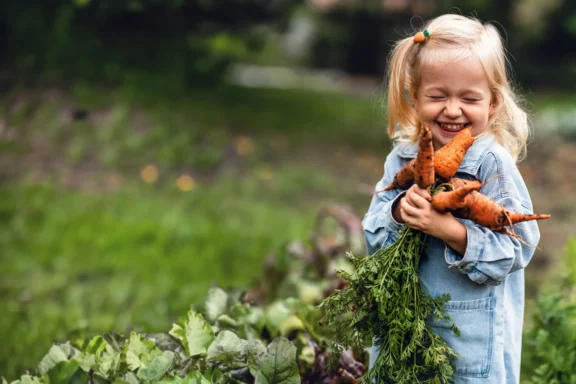
You don’t need a big backyard — or even a backyard at all — to grow something beautiful with your child this summer. A sunny windowsill, a few small pots, and a little curiosity are all it takes.
Gardening with kids isn’t just about plants — it’s about patience, wonder, and conversation. And when you weave in a second language along the way? That’s where the real magic happens.
🏢 Small Apartment? No Problem!
Living in a small space is absolutely no barrier to gardening with kids. A few pots on a windowsill, a hanging planter on a balcony railing, or even recycled yogurt containers on a shelf can become your child’s very own garden. Herbs, cherry tomatoes, and lettuce all thrive in small containers — and they grow quickly enough to keep kids genuinely excited. The garden doesn’t have to be big. It just has to be theirs.
🌿 1. The Seed Naming Game
Before you plant anything, sit together and look at the seeds. Talk about what they are in both languages — “These are basil seeds / Ce sont des graines de basilic.” Let your child make a little bilingual label for each pot: Mint / Menthe, Tomato / Tomate. This simple act of naming is one of the most natural vocabulary lessons you can give — they won’t even realize they’re learning.
Research backs this up: a peer-reviewed study by Lipner et al. (2021) found that bilingual children develop richer word knowledge when vocabulary is reinforced across both languages simultaneously — exactly what happens when a child writes “Mint / Menthe” on a handmade label. (Frontiers in Psychology)
💧 2. The Daily Watering Routine
A watering routine is a gift that keeps giving all summer. Every morning, your child waters their plants while you narrate together: “The soil is dry today — la terre est sèche.” or “Look, it’s growing! — Regarde, ça pousse !” Language learned through repeated, sensory experience is language that truly sticks.
Apartment tip: A south-facing window is perfect for herbs and cherry tomatoes indoors. Place pots on a waterproof tray to keep things tidy.
🍓 3. The Harvest Treasure Hunt
When the first little tomato or sprig of mint is ready, make it a celebration! Hand your child a small basket and send them on a chasse au trésor de la récolte. As they pick each item, ask: “What color is it? — De quelle couleur est-il?” and “How many did we grow? — Combien en avons-nous fait pousser?” Colors, numbers, textures — all learned in the most memorable way possible.
This kind of hands-on, nature-based activity does more than build vocabulary. According to a 2025 study published in Acta Psychologica, gardening activities in early childhood settings support cognitive flexibility, emotional regulation, and sensory development in young children. (ScienceDirect)
🍳 4. From the Garden to the Kitchen
This is where language learning comes full circle. Wash the mint together, tear the basil leaves, taste everything along the way — and narrate every step in both languages. A few simple recipes that work beautifully with a small container garden:
- Mint lemonade — Limonade à la menthe 🍋
- Basil butter on toast — Beurre au basilic 🍞
- Cherry tomato and herb salad — Salade de tomates cerises aux herbes 🍅
🎨 5. The Garden Journal
Invite your child to keep a little journal de jardin all summer long. Each week, they draw their plants and write one sentence in both languages about what they noticed: “Our basil grew two new leaves this week. — Notre basilic a fait pousser deux nouvelles feuilles.” By September, they’ll have a beautiful keepsake — and a full summer of bilingual writing practice without even trying.
🌍 The Bigger Picture
Gardening teaches children that growth takes time and that small things matter. When you layer language learning gently into those everyday moments, you’re giving your child something no classroom alone can replicate. A systematic review by Ohly et al. (2023) confirmed that school gardening programs consistently improve children’s wellbeing, motivation, and engagement with learning — benefits that translate just as powerfully to a home balcony garden. (MDPI — International Journal of Environmental Research and Public Health)
And the best part? It works whether you have two acres or two pots on a windowsill.
At Langmobile, we believe language learning happens everywhere — in the classroom, at camp, and yes, even in your kitchen garden. If you’d love to keep your child’s second language growing all summer long, our Summer Camps and Online Classes are a wonderful place to start. 🌱
📚 Research & Further Reading
- Bilingual Vocabulary Learning in Young Children Lipner, Armon-Lotem, Walters & Altman (2021). Crosslinguistic Influence of Lexical Breadth and Depth in the Vocabulary of Bilingual Kindergarten Children. Frontiers in Psychology. 🔗Link
- Gardening & Early Childhood Development Craig et al. (2025). Effect of Gardening Activities in Early Childhood Education Institutions. Acta Psychologica, ScienceDirect. 🔗Link
- Gardening & Child Well-Being Ohly et al. (2023). School Gardening and Health and Well-Being of School-Aged Children: A Realist Synthesis. MDPI International Journal of Environmental Research and Public Health. 🔗Link
🌟 For more engaging learning ideas, visit our blog weekly! We share creative activities, language tips, and more to make learning exciting. Stay connected with the latest posts on the Langmobile blog! And don’t forget to check out awesome songs on our Apple Music, YouTube, and Spotify pages to help with your language learning!