The Hidden Power of Outdoor Play for Child Development 🌿
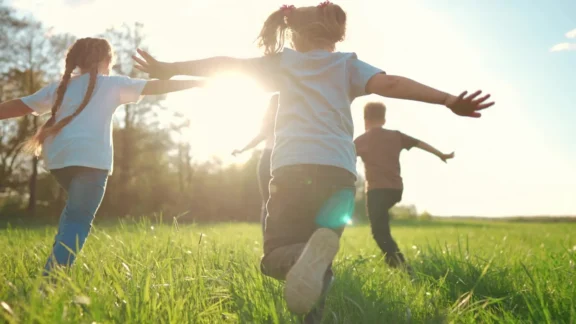
There’s something quietly magical about watching a child play outside.
No instructions. No screens. No expectations.
Just curiosity, movement, and imagination unfolding in real time.In a world that feels increasingly structured, scheduled, and digital, outdoor play might seem simple—even secondary. But research tells us something very different:
It’s not just play. It’s development in its purest form.
🌱 More Than “Just Playing”: What’s Really Happening Outside
When children step outdoors, something shifts.
They run differently. Think differently. Even interact differently.
Unlike indoor environments, outdoor spaces invite unpredictability—uneven ground, changing weather, new sounds, and endless possibilities. These elements challenge children in ways that structured environments often cannot.
A recent systematic review found that outdoor play environments are strongly associated with improvements in children’s physical activity, behavior, and overall health outcomes (Schipperijn et al., 2024) .
But it goes deeper than physical health.
Outdoor play creates space for children to:
- Solve problems independently
- Take safe risks
- Develop resilience
- Engage socially in more natural ways
It’s unstructured—which is exactly why it’s so powerful.
🧠 The Brain on Nature: Cognitive and Emotional Growth
One of the most fascinating findings in recent research is how outdoor play supports early cognitive development.
A large 2024 study of over 10,000 preschoolers found that children who spent more time playing outdoors showed significantly better school readiness, including cognitive and psychosocial development (Duncan et al., 2024) .
In simple terms?
Children who play outside more are often better prepared to learn.
Why?
Because outdoor environments naturally encourage:
- Attention and focus
- Creative thinking
- Memory and problem-solving
At the same time, outdoor play supports emotional development. Children learn how to navigate uncertainty—climbing a little higher, running a little faster, trying something new.
A 2026 scoping review highlights that even “risky play” (like climbing, exploring, or balancing) helps children build confidence, emotional regulation, and resilience (Gray et al., 2025) .
And maybe that’s the key:
Outdoor play doesn’t remove challenges—it teaches children how to face them.
🌍 The Environment Matters More Than We Think
Where a child grows up can shape how they play—and how they develop.
A recent population-based study in Canada found that children living in more “playable” neighborhoods (with access to safe outdoor spaces, greenery, and social environments) showed better early developmental outcomes (O’Neill et al., 2026) .
This tells us something important:
Outdoor play isn’t just about time.
It’s also about access.
Children need spaces where they feel safe, free, and inspired to explore.
And when they have that? The benefits ripple across every area of development—physical, cognitive, social, and emotional.
🌈 Why Outdoor Play Feels Different (And Why That Matters)
Think about the difference between:
- A child sitting at a table completing a task
vs. - A child building a world out of sticks, rocks, and imagination
One is guided.
The other is self-led.
Outdoor play gives children ownership over their experience. They decide:
- What to play
- How to play
- Who to play with
This autonomy builds confidence in a way structured environments often can’t.
It also supports something many children today are missing: boredom.
And boredom?
It’s where creativity begins.
💛 A Gentle Reminder for Parents
In 2026, it’s easy to feel like we need to do more for our children—more activities, more structure, more “learning.”
But sometimes, the most powerful thing we can give them is… space.
Space to explore.
Space to get messy.
Space to be free.
Outdoor play doesn’t require perfection, planning, or pressure.
Just time.
Even 20–30 minutes a day can make a difference.
Because in those small, quiet moments outside, children are doing something extraordinary:
They are building the foundation for who they will become.
✨ Final Thought
Outdoor play may look simple—but it’s anything but.
It is where confidence grows, where curiosity expands, and where childhood feels most alive.
And in a fast-paced, screen-filled world, it might just be one of the most important things we can protect.
📚 References
- Duncan, M. J., Eyre, E. L. J., & Bryant, E. (2024). Nature and success: Outdoor play is linked to school readiness. Complementary Therapies in Clinical Practice, 55, 101895. Link
- Gray, T., Down, M. J. A., Mann, J., Barnes, J., & Eager, D. (2025). Risky outdoor play and adventure education in nature for child and adolescent wellbeing: A scoping review. Behavioral Sciences, 16(1), 5. Link
- O’Neill, M., et al. (2026). Neighborhood playability and early childhood development: A population-based birth cohort study. Environmental Research. Link
- Schipperijn, J., et al. (2024). The role of playgrounds in promoting children’s health: A scoping review. International Journal of Behavioral Nutrition and Physical Activity, 21(1), 72.Link
🌟 For more engaging learning ideas, visit our blog weekly! We share creative activities, language tips, and more to make learning exciting. Stay connected with the latest posts on the Langmobile blog! And don’t forget to check out awesome songs on our Apple Music, YouTube, and Spotify pages to help with your language learning!